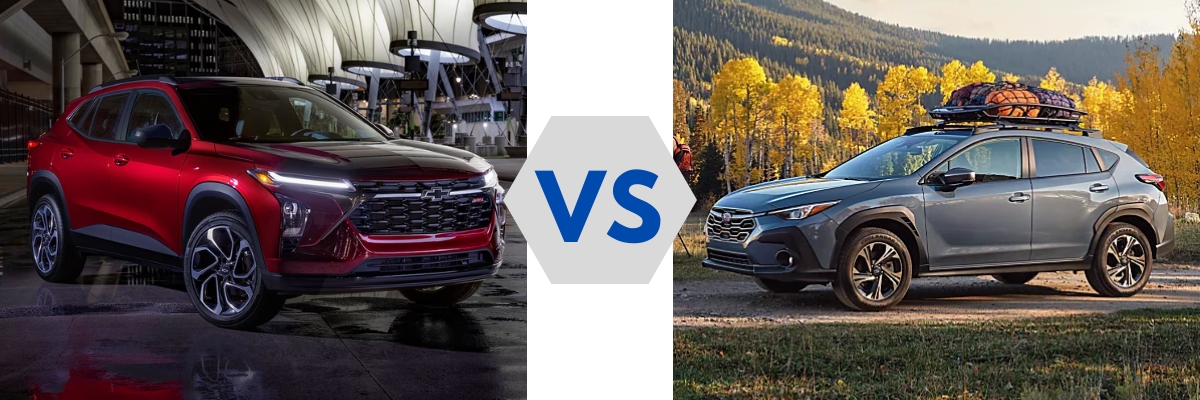

2026 Chevy Trax vs 2026 Hyundai Kona

The Trax returns as Chevy's most affordable SUV option. While there are no major changes this year, Chevy rolled out updates to keep the Trax's modern feel. See how it stacks up against a tough competitor, the popular Hyundai Kona, below!
Key Takeaways

- Chevy introduces new paint options for the 2026 Trax, while Hyundai removes several popular trims from the Kona's lineup.
- The Trax and the Kona are top choices for buyers on a budget.
- You get more modern standard tech in the Trax.
- As of May 28, 2026, the Trax is the more affordable choice.
Trax vs Kona Updates and Pricing in 2026

Chevy brings in two new colors, White Sands and Apex Red, while dropping Nitro Yellow and Crimson Metallic. The automaker also removed some accessory bundles--these include the highway safety kit and premium carpeted mats.
The Trax stands out for its affordable price. Finding a brand-new SUV (or any vehicle, for that matter) for less than $30k can be challenging, but the Trax's trims are all well below that mark. The LS starts at only $23,495, the 1RS and LT are $24,995, and the top-level 2RS and ACTIV are $27,195.
The Kona has few changes, and most involve streamlining the trim. Hyundai cut the SEL, N Line, and other variants in favor of SEL Sport and SEL Premium. Adaptive cruise control is now standard across the board.
For 2026, pricing has increased slightly:
- SE: $27,100
- SEL Sport: $28,275
- SEL Premium: $30,025
- Limited: $34,135
| 2026 Chevy Trax | 2026 Hyundai Kona |
|---|---|
| New colors added, some colors discontinued; Select accessory bundles discontinued | EL, N Line and variations cut from lineup |
| Full lineup remains intact across trims | Adaptive cruise control added across the board |
| Trims are $23,495 to $27,195 | Trims are $27,100 to $34,135 |
Powertrains in the Trax and Kona in 2026

Trax models feature a 1.2-liter turbo three-cylinder engine delivering 137 horsepower through a six-speed automatic transmission. It's FWD only, which keeps the price down, but the turbocharged punch nevertheless feels responsive in traffic.
The Kona's standard 2.0-liter engine is nearly equivalent in power with 147 horses. Hyundai offers a punchier 1.6-liter turbo with 190 horsepower, but you have to spend more to get it. (Both pair with an 8-speed automatic.)
Tech and Creature Comforts in Trax and Venue
Chevy stretched the wheelbase to maximize cabin space, giving passengers in the back plenty of room to stretch their legs, while the deep cargo hold swallows up pretty much whatever you need to carry. Inside, the cabin materials are durable and built for real life. Standard models launch with an 8-inch screen, but moving up to the LT trim or beyond upgrades you to an 11-inch touchscreen alongside an 8-inch digital gauge cluster. Plus, you get wireless Apple CarPlay and Android Auto across the board without paying extra.
The Kona counters with a standard 12.3-inch touchscreen, but its cheaper models leave drivers staring at a tiny 4.2-inch display. While the more expensive Kona trims eventually close the tech gap with Chevy, you have to spend thousands more to unlock those features.
Which Is the Best Small SUV for Commuting and Daily Driving?
The Kona is solid, but the Trax is the better SUV at a more affordable price. It gives you more cargo space and legroom, and its modern tech perks rival those of luxury vehicles, all while remaining one of the most affordable SUVs you can buy. Contact Banner Chevrolet today for a test drive!